
Saline vs Silicone Implants: Which Should You Choose?
Last updated on September 28, 2026
Medically reviewed by Mr. Alfie, MBBCh, MSc, FRCS Plastic Surgery, Last reviewed: August 2026.
The main difference between saline vs silicone implants is what sits inside the implant shell. Saline implants contain sterile saltwater, while silicone implants are pre-filled with a cohesive silicone gel. This affects their feel, the way they behave within the breast, and what happens if the implant ruptures.
Filling material is only one part of breast augmentation planning. Existing breast tissue, skin quality, chest width and the amount of coverage over the implant all influence which option is appropriate. At Delta Clinics, these factors are considered together rather than choosing an implant based on one perceived advantage.
What are Breast Implants Made Of?
Both saline and silicone breast implants have an outer shell made from medical-grade silicone. Describing one option as saline does not mean the implant is entirely free from silicone, as the name refers to the material used to fill the shell.
When comparing different types of breast implants, filling material is only one characteristic. Implants also vary in size and shape, profile, shell surface and firmness, all of which influence how they sit within the breast and affect the final result.

Saline and silicone implants share an outer silicone shell but contain different filling materials.
What are Silicone and Saline Breast Implants?
Silicone breast implants are pre-filled with a cohesive gel designed to hold together within the outer shell. They are the type most frequently used for breast augmentation in the UK and generally provide a softer, more tissue-like feel with less visible rippling than saline.
Saline implants contain sterile saltwater and can be inserted empty before being filled during surgery. This allows some adjustment of volume before the incision is closed, although saline implants tend to feel firmer and are more prone to folds or rippling where natural tissue coverage is limited.
Saline vs Silicone Implants: The Key Differences
The two implant types share many of the same surgical considerations, but their fillings create several practical differences. These relate mainly to feel, tissue coverage, incision planning and how implant failure becomes apparent.
| Criterion | Saline Implants | Silicone Implants |
|---|---|---|
| Filling | Sterile saltwater | Cohesive silicone gel |
| Outer shell | Medical-grade silicone | Medical-grade silicone (Note: both share the same shell material) |
| Feel | Firmer, less tissue-like | Softer, closer to natural breast tissue |
| Rippling risk | Higher, especially with limited tissue coverage | Lower, but still possible |
| Incision size | Potentially smaller (inserted empty, then filled) | Determined by implant size/shape (arrives pre-filled) |
| Volume adjustment during surgery | Possible | Not possible |
| If it ruptures | Visibly deflates; saline absorbed safely by the body | Can be silent; may require MRI/ultrasound to detect |
| UK usage | Less common | Most commonly used |
Feel and Movement: Saline vs Silicone
Silicone gel generally behaves more like natural breast tissue and creates a softer transition between the implant and the surrounding breast. Saline implants can feel firmer or less tissue-like, particularly when there is limited natural coverage over the shell.
Rippling and Tissue Coverage: Saline vs Silicone
All implants can develop folds or rippling, but saline implants are more susceptible. Silicone implants can also ripple if the implant is large in relation to the available tissue or positioned where coverage is limited, making appropriate sizing and placement relevant to either option.
Incision Size and Volume Adjustment: Saline vs Silicone
Saline implants can be inserted before they are filled, which can allow a smaller incision in some circumstances and provides some control over volume during surgery. Silicone implants arrive pre-filled, so the incision required depends on the implant’s size, shape and the surgical approach used.
What Happens if a Saline or Silicone Implant Ruptures
A saline implant generally becomes visibly smaller if it ruptures because the fluid escapes and is absorbed by the body, although the deflated shell still requires surgical assessment. Silicone implant rupture can be less obvious because cohesive gel may remain within the shell or surrounding capsule, sometimes requiring imaging to investigate.
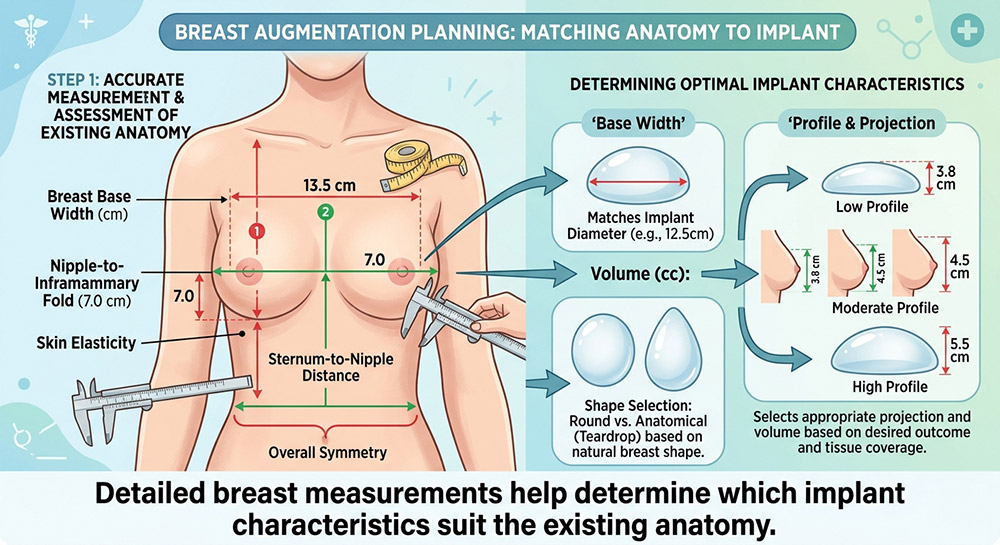
Detailed breast measurements help determine which implant characteristics suit the existing anatomy.
Are Saline Implants Safer Than Silicone Implants?
No, saline implants are not inherently safer than silicone implants simply because they contain sterile saltwater. Both types have a silicone outer shell, require surgery and share risks such as infection, changes in sensation, capsular contracture, implant displacement, rupture and the possibility of further surgery.
The wider safety profile also involves factors beyond the implant filling. Rare implant-associated conditions are assessed in relation to characteristics such as the shell surface and surrounding capsule, so choosing saline does not remove the risks associated with having a breast implant. The MHRA publishes current guidance on breast implant associated anaplastic large cell lymphoma (BIA-ALCL), including how rare it is and what patients should discuss with their surgeon before consenting to surgery.
How Anatomy, Shape and Size Influence Implant Choice
Breast implant selection begins with measurements and examination rather than choosing a filling material from a list. Round and teardrop implants distribute volume differently, while implant size, profile and placement affect projection, tissue coverage and how noticeable the implant edges become.
Your assessment will consider:
- Existing breast volume and shape
- Breast and chest width
- Skin quality and elasticity
- Thickness of the breast tissue
- Nipple position
- Differences between the breasts
- Desired volume and projection
- Implant position above or below the muscle
- The level of upper-breast fullness requested
- Lifestyle and long-term expectations
Saline or Silicone Implants: Which Should You Choose?
For most people considering breast augmentation in the UK, silicone gel implants are likely to form the main part of the discussion. They are widely available, come in numerous shapes and profiles and generally provide a softer feel with less visible rippling than saline. However, the right implant must still fit the breast dimensions, have adequate tissue coverage and support the intended change without placing unnecessary strain on the skin. The NHS guidance on breast enlargement also confirms that silicone implants are the type most commonly used in the UK, and sets out the checks to make before choosing a surgeon, including confirming GMC specialist register status and CQC registration of the clinic.
At Delta Clinics, we use detailed measurements and a sizing process to explain how different implant characteristics influence the result. Rather than considering saline and silicone in isolation, your consultation will look at how filling, size, shape, profile and placement combine within a complete breast augmentation plan.
Book a Breast Augmentation Consultation in London
If you are comparing saline and silicone implants, a private consultation provides the opportunity to discuss which options are available and how each behaves within your anatomy. Delta Clinics offers personalised breast augmentation planning led by an experienced plastic surgeon, with clear information about implant choice, surgery, recovery and long-term care.
Contact us today to book your consultation:
- WhatsApp: 07498213451
- Call us: 02034410450
- Email: info@deltaclinics.co.uk
Saline vs Silicone Implants: FAQs
Do saline and silicone implants come in different shapes and profiles?
Both implant types are available in different sizes and profiles, although the exact range depends on the manufacturer. Silicone implants offer a particularly broad selection of gel consistencies and shapes within the UK market.
Can you switch from saline to silicone implants later?
Yes, saline implants can be replaced with silicone implants during revision surgery. Your surgeon will assess the existing implant pocket, capsule, breast tissue and reason for replacement before recommending the most appropriate new implant.
Does implant type affect breast screening?
Both saline and silicone implants can obscure some breast tissue during mammography. You should tell the screening service that you have implants so appropriately trained staff can use additional views and techniques where required.
Do saline and silicone implants last the same length of time?
Neither type should be treated as a lifetime device, but there is no universal date at which every implant must be replaced. Implant condition, symptoms, breast changes and the manufacturer’s information are more relevant than scheduling replacement solely because a certain number of years has passed.
Can both saline and silicone implants develop capsular contracture?
Yes, capsular contracture can occur around either type because the capsule forms around the outer implant shell rather than its filling. If the capsule tightens, the breast can become firmer, change shape or feel uncomfortable, requiring further assessment.
Do silicone and saline implants require different aftercare?
Immediate recovery instructions are generally determined by the operation, incision and implant position rather than the filling material. Both require wound care, activity restrictions, supportive garments where advised and attendance at planned follow-up appointments.
Can either implant type be used to correct breast asymmetry?
Different implant sizes or profiles can improve selected volume differences between the breasts. Saline volume can be adjusted during surgery, but this does not automatically make it the better option because nipple position, breast shape, tissue quality and chest asymmetry also influence the result.
Can you breastfeed with saline or silicone implants?
Many women can breastfeed after having either type of implant, and the filling material itself does not normally determine breastfeeding ability. The incision location, implant position, individual anatomy and any changes to breast tissue or nerves can influence milk production.




30 September 2026
How Much Does Liposuction Cost in the UK? What Affects the Price

23 September 2026
5 August 2026

15 July 2026

 Online Marketing For Doctors