

As Featured In


This content has been medically reviewed by Mr Alfie, MBBCh, MSc, FRCS Plastic Surgery, Last reviewed: September 2026.


 Trustindex verifies that the original source of the review is Google.
 Trustindex verifies that the original source of the review is Google.
 Trustindex verifies that the original source of the review is Google.
 Trustindex verifies that the original source of the review is Google.
 Trustindex verifies that the original source of the review is Google.
 Trustindex verifies that the original source of the review is Google.
 Trustindex verifies that the original source of the review is Google.
 Trustindex verifies that the original source of the review is Google.
 Trustindex verifies that the original source of the review is Google.
 Trustindex verifies that the original source of the review is Google.
A breast that becomes hard, painful or visibly misshapen after implant placement needs assessment. One possible cause is capsular contracture, where the scar tissue around the implant tightens. It may affect one breast or both, sometimes creating an obvious difference between them.
Not every change in an implanted breast is capsular contracture. The breast and implant need to be assessed before a decision is made about monitoring, further investigation or treatment. If a procedure is appropriate, the plan depends on the condition of the capsule and whether you wish to keep the implants.

What Is Capsular Contracture?
The body normally forms a thin layer of scar tissue, called a capsule, around a breast implant. In capsular contracture, that tissue becomes unusually firm and tight. As it contracts around the implant, the breast can feel harder, and its shape or position can change.
A capsule is an expected part of healing after implant surgery; its presence alone is not a complication. Capsular contracture describes the point at which tightening causes a noticeable change in how the breast feels or looks, and sometimes causes discomfort or pain.
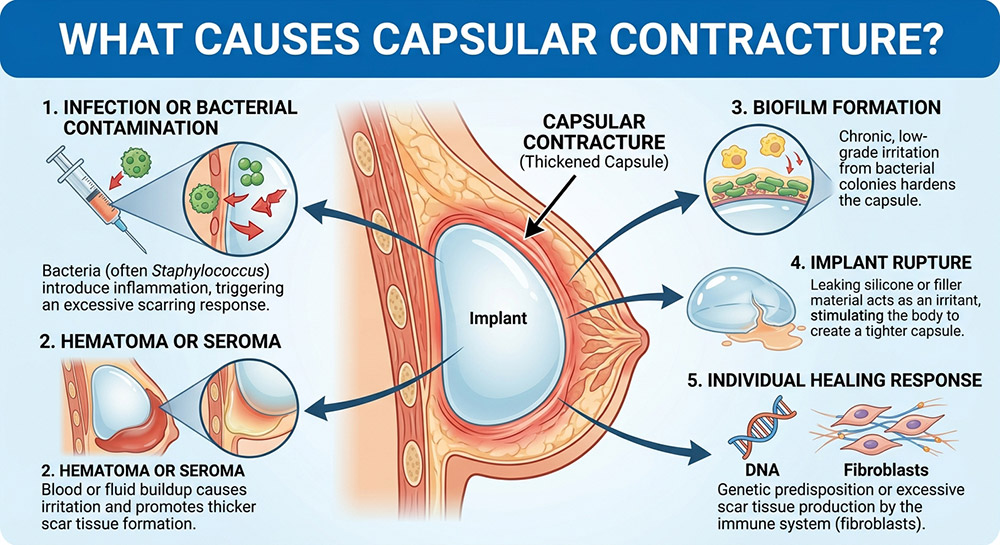
What Causes Capsular Contracture?
Capsular contracture can develop within months of breast augmentation or years later. Changes around the implant and the way surrounding tissue heals can influence how the capsule forms and tightens.
Factors associated with capsular contracture include:
- Inflammation around the implant
- Bacterial contamination of the implant pocket
- Bleeding or fluid collection after surgery
- Implant rupture or another change affecting the implant
- A previous episode of capsular contracture
- Individual differences in healing and scar formation
What Are the Signs of Capsular Contracture?
An affected breast may feel firmer than it used to, or firmer than the other breast. As the capsule tightens, it can alter the implant’s shape or draw it into a different position. More advanced contracture may cause persistent discomfort or pain.
Changes worth assessing include:
- Increasing breast firmness or tightness
- A breast that appears unusually round, high or distorted
- A new difference in shape or position between the breasts
- Discomfort when pressure is placed on the breast
- Pain associated with a hard, misshapen breast
A new lump, unexplained swelling or another unexpected breast change should be assessed promptly by a qualified medical professional. These symptoms can have causes other than capsular contracture, so it is important to establish what has changed rather than assume the capsule is responsible.

How We Assess Capsular Contracture
at Delta Clinics
Assessment begins with your implant and surgical history, including when the implants were placed and whether you have had previous breast procedures. The examination establishes the degree of firmness, the position of each implant, any change in breast shape, and whether there is tenderness. Imaging may be recommended if there is concern about implant rupture or the examination does not fully explain your symptoms.
Surgeons may describe severity using the Baker grading scale. At one end, a breast looks and feels normal; at the other, it is hard, visibly distorted and painful. The grade helps describe the findings, but the decision about treatment also depends on your symptoms, the condition of the implant and what you would like to do with it.
Capsular Contracture Treatment Options
at Delta Clinics
Mild changes do not automatically require treatment and may be monitored instead. When contracture causes significant firmness, distortion or pain, a procedure may be considered to address the tightened capsule and implant. The extent of capsule treatment is decided during surgical planning; complete removal is not necessary or appropriate in every case.
Breast Implant Removal
If you no longer wish to have implants, breast implant removal is the appropriate approach. The implant is removed, and the tightened scar tissue around it can be released or removed where clinically necessary. The surgeon will also assess the shape likely to remain after removal and discuss whether a breast uplift would be suitable.
Breast Implant Replacement
If you wish to retain the volume achieved through breast augmentation, implant replacement may be considered. The existing implant is removed, the contracted capsule is treated, and a new implant is placed. Adjusting the implant pocket may also be necessary to improve its position. Planning takes account of the breast tissue and the possibility that contracture could recur.
Why Choose Delta Clinics for
Capsular Contracture Treatment?
Planning revision treatment begins with establishing what has changed in the breast and around the implant. At Delta Clinics, we assess firmness, distortion, and discomfort, along with the implant’s condition and your previous procedure, before treating the capsule or implant. We then base our recommendations on those findings and your preference about keeping or removing implants.
Patients benefit from:

Assessment by a plastic surgeon experienced in implant and breast procedures

Examination of breast shape, implant position and the degree of firmness

Imaging recommendations when implant integrity needs further investigation

Discussion of removal or replacement according to the clinical findings and your goals

Capsule treatment planned for the tissue involved, rather than a fixed approach

Clear advice about scars, recovery and the risk of recurrence

Clinical follow-up as the breasts heal after revision treatment
Book a Capsular Contracture Consultation
If a breast implant has become hard, painful or changed shape, contact Delta Clinics to discuss your concerns or book a consultation online. Our surgical team can assess what has changed, advise whether further investigation is needed and explain the treatment options available to you.
- WhatsApp: 07498213451
- Call: 02034410450
- Email: info@deltaclinics.co.uk
Capsular Contracture FAQs
Is it normal to have a capsule around a breast implant?
Yes. The body forms a thin layer of scar tissue around an implant as part of its normal response. Capsular contracture occurs when that tissue tightens enough to make the breast unusually firm or change its appearance.
Can capsular contracture affect just one breast?
Yes, one breast can develop contracture while the other remains soft. That difference may make the breasts look uneven or cause the affected side to feel tighter.
What do the Baker grades of capsular contracture mean?
The Baker scale describes how a breast with an implant looks and feels, from a normal, soft breast at grade I to a hard, painful and visibly distorted breast at grade IV. It gives us a shared way to describe severity, but treatment also depends on your symptoms and examination findings.
Does a hard breast implant always mean capsular contracture?
No. Capsular contracture is one possible explanation for increasing firmness, but other implant or breast changes may need to be considered. An examination and imaging, when appropriate, can help establish the cause.
Can capsular contracture be treated without a procedure?
A mild change that causes little or no difficulty may be monitored rather than treated immediately. Established contracture causing marked distortion or pain generally needs assessment by a plastic surgeon to determine what correction is possible.
Does the entire capsule have to be removed?
Not always. The surgeon assesses which capsule tissue is thickened or causing the problem and plans treatment around the implant and surrounding anatomy. The proposed extent of capsule removal will be explained during your consultation.
Can I have my implants removed without replacing them?
Yes. Implant removal is an option if you no longer want implants, and any necessary capsule treatment can be planned at the same time. The surgeon will explain how the breasts may look afterwards and whether additional reshaping is suitable.
How long is recovery after capsular contracture treatment?
Recovery varies with the extent of capsule treatment and whether the implants are removed or replaced. Swelling, tenderness and activity restrictions are expected in the early weeks, while breast shape continues to settle as healing progresses. Your surgeon will give you instructions for your specific procedure.
Can capsular contracture return after implant replacement?
Yes, it can recur even after the contracted capsule is treated and the implant is replaced. That possibility will be discussed when comparing replacement with implant removal so that you can make a decision with realistic expectations.
Will treatment restore the breasts to exactly how they looked before contracture?
Treatment can address the tightened capsule and improve the changes it has caused, but the result depends on the condition of your breast tissue and implants. Previous procedures, skin changes and healing all affect the final shape, which will be discussed during your assessment.
Request a Consultation
Complete the form below and we will get back to you shortly to schedule an appointment.
 Online Marketing For Doctors