
Breast Implants vs Fat Transfer: Which Breast Augmentation Option Is Right for You?
Last updated on March 17, 2026
Understanding Two Different Approaches to Breast Augmentation
Breast augmentation can be achieved using more than one technique, and the method chosen has a significant impact on both the outcome and how predictable that outcome will be over time. One of the most common comparisons people explore is breast implants vs fat transfer, as both aim to increase breast volume but do so in very different ways.
Rather than viewing these options as interchangeable, it is important to understand how each approach works, what it can realistically achieve and where its limitations lie. A clear comparison helps set realistic expectations and supports better decision-making before any surgical consultation.
Volume and Size Potential
One of the first and most practical considerations when comparing breast implants and fat transfer is how much volume can realistically be achieved. The two techniques differ significantly in this respect, which often makes this a deciding factor.
With Implants
Breast implants allow for a clearly defined and predictable increase in size. Because implants are available in a wide range of volumes and profiles, surgeons can plan outcomes with a high level of accuracy, making this approach suitable for those seeking a moderate to significant size increase. The volume achieved is immediate and stable, which provides clarity and confidence in the expected result.
With Fat Transfer
Fat transfer to breasts offers a more limited increase in size. The amount of volume that can be added depends on donor fat availability and how much of the transferred fat survives long-term. As some reabsorption is expected, results tend to be more subtle, making this option better suited to those seeking refinement rather than a noticeable change in size.
Shape, Projection and Breast Contour
Breast shape is influenced by more than size alone. Projection, upper breast fullness and overall contour play a major role in how the final result appears, and this is another area where implants and fat transfer differ clearly.
With Implants
Implants provide internal structure, allowing for greater control over projection, upper pole fullness and breast contour. This makes implants particularly effective for creating a defined shape and improving cleavage when appropriate for the individual’s anatomy. Shape can be planned alongside size, offering a higher degree of surgical control.
With Fat Transfer
Fat transfer enhances shape in a softer, more diffuse way. Transferred fat settles into existing tissue and follows natural contours rather than creating structure, which can improve balance and softness but offers limited control over projection or cleavage. The result is typically a more blended and understated enhancement.
Look and Feel of the Final Result
How the breasts look and feel after surgery is a common concern, but “natural” results depend on technique, anatomy and expectations rather than the method alone.
With Implants
Modern implants, when carefully selected and placed, can look and feel natural within the body. Implant type, placement and the characteristics of the existing breast tissue all influence the final result, and when these factors are well matched, implants can integrate seamlessly with natural movement.
With Fat Transfer
Because fat transfer uses the patient’s own tissue, the breasts often feel soft and natural once healing is complete. The transferred fat integrates with existing tissue, although variations in fat survival can affect long-term consistency in both appearance and feel.
Predictability and Longevity of Results
Long-term behaviour is an important consideration when weighing up breast implants versus fat transfer, particularly for those who value certainty in planning.
With Implants
Implants provide a predictable and clearly defined result from the time of surgery. While they are not lifetime devices and may require monitoring or future revision, their performance over time is well understood, allowing for straightforward long-term planning.
With Fat Transfer
Fat transfer results are less predictable, as a portion of the transferred fat is naturally reabsorbed during healing. Final volume can take several months to stabilise, and in some cases, additional procedures may be needed to achieve the desired outcome.
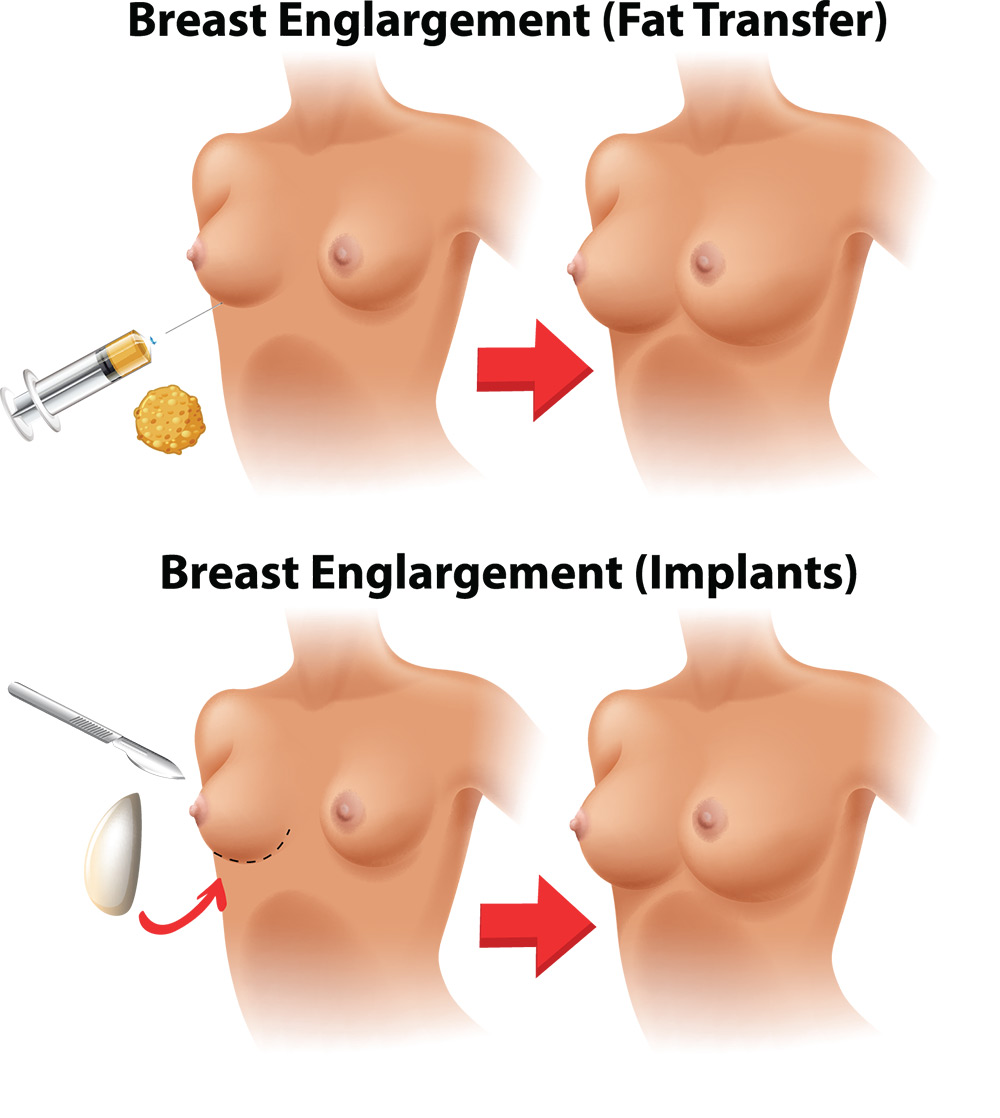
Understanding the differences between breast implants vs fat transfer allows patients to choose an approach that aligns with their anatomy and aesthetic goals.
Body Type and Practical Considerations
An individual’s anatomy plays a central role in determining which approach may be more appropriate. Factors such as body composition, existing breast tissue and skin quality all influence outcomes.
With Implants
Because implants do not rely on donor fat, they can be used across a wide range of body types, including very lean individuals. Chest width, skin elasticity and breast dimensions guide implant selection and placement to achieve proportionate results.
With Fat Transfer
Fat transfer requires adequate donor fat, which may limit suitability for leaner individuals. It is generally best suited to those who have sufficient donor fat and are seeking a modest increase in volume rather than a dramatic change.
Recovery and Overall Treatment Trade-Offs
Recovery is often oversimplified when comparing these two approaches, yet it differs in meaningful ways that should be understood in advance.
With Implants
Recovery is focused on the chest, with an initial period of discomfort and activity restriction as the tissues heal around the implants. Most individuals gradually return to normal activities as healing progresses.
With Fat Transfer
Fat transfer involves recovery from both breast enhancement and liposuction at the donor sites, meaning there are multiple areas of healing to consider. This can influence the overall recovery experience and should be factored into decision-making.
Can Breast Implants and Fat Transfer Be Combined?
In some cases, implants and fat transfer can be combined in a hybrid approach. This allows implants to provide reliable volume and structure, while fat transfer is used to refine shape and soften contours. Hybrid breast augmentation offers an option for individuals whose goals sit between subtle enhancement and more defined augmentation, allowing for a more tailored result.
Final Thoughts
Choosing between breast implants and fat transfer is not about finding a universally “better” option. Each approach serves a different purpose and produces different outcomes, and the most appropriate choice depends on anatomy, goals and expectations.
Understanding how implants and fat transfer differ in terms of volume, shape, predictability and long-term behaviour allows for more meaningful discussions and realistic planning. A considered, individualised approach is always the foundation of a balanced and well-proportioned result.
Take the Next Step with Delta Clinics
If you are considering breast augmentation, Delta Clinics offers private consultations where you can discuss your concerns and receive clear, personalised guidance based on your individual anatomy and goals.
Contact us today to book your consultation:
WhatsApp: 07498213451
Call us: 02034410450
Email: info@deltaclinics.co.uk
FAQs
Is fat transfer or breast implants better?
Neither option is universally better, as each approach is designed to achieve different outcomes. The most suitable choice depends on factors such as desired volume, anatomy and how predictable you want the result to be.
Can fat transfer replace breast implants?
Fat transfer can enhance breast volume, but it cannot reliably achieve the same level of size increase or structural shaping as implants. For individuals seeking a significant or clearly defined change, implants are often more appropriate.
Which option looks more natural, implants or fat transfer?
A natural result depends on anatomy, technique and expectations rather than the method alone. Both implants and fat transfer can produce natural-looking outcomes when carefully planned and performed.
How long do fat transfer breast augmentation results last?
The fat that survives after transfer can be long-lasting, but some reabsorption is expected during the healing process. Final results typically stabilise over several months, and additional procedures may sometimes be needed.
Is recovery easier with fat transfer than breast implants?
Recovery experiences differ, rather than one being definitively easier. Fat transfer involves healing at both the breasts and donor sites, while implant recovery is focused primarily on the chest.





 Online Marketing For Doctors